Why I'm Running


Our Town's future success depends on leaders who are willing to stand up for the Erie residents - individuals willing to ask the tough questions and challenge the status-quo, individuals who are Forward Thinking for Erie's Future!

My Priority Items

Erie quickly moved from "the best kept secret" to "the gem of North Metro Denver", becoming a destination others have wanted to call home. Due to our rapidly-growing community, Erie has faced many issues which are all central to growth management.

The Town has grown faster than ever before, moving from a population of just over 6,000 residents in 2000, to 30,000 in 2020,  and now a staggering population of over 42,000 residents as of 2026. From 2015 to 2020, and then again 2020-2025, the Town will grew nearly 40%. Understanding the actual growth rate is important, because the town has historically only forecast and planned for a 15% rate over these same periods of time. Whether it be the lifespan of a roadway, or capacity of our water and sewer enterprises – these infrastructure pieces have become strained due to our Town's rapid growth. 


Additionally, our Town's resources have become limited over this time period. Most notably, water for new development has had to be restricted due to lack of availability. This now puts many of these projects Town wide - residential, commercial, and otherwise - into a questionable position as to if or when they will actually happen.


In order to become forward thinking, we must first restore our confidence in the Town by beginning with understanding the facts: What is our current population? What will our population be based on key intervals or years into the future? What is the capacity for our infrastructure and resources? When, and specifically where, will our capacity levels be met at these times? From these questions, we can begin to think towards the future, always staying one step ahead as Erie continues to grow.

Sustainable Infrastructure
& Resources

Sustainable Infrastructure
& Resources

The Town has grown faster than ever before, moving from a population of just over 6,000 residents in 2000, to 30,000 in 2020,  and now a staggering population of over 42,000 residents as of 2026. From 2015 to 2020, and then again 2020-2025, the Town will grew nearly 40%. Understanding the actual growth rate is important, because the town has historically only forecast and planned for a 15% rate over these same periods of time. Whether it be the lifespan of a roadway, or capacity of our water and sewer enterprises – these infrastructure pieces have become strained due to our Town's rapid growth. 


Additionally, our Town's resources have become limited over this time period. Most notably, water for new development has had to be restricted due to lack of availability. This now puts many of these projects Town wide - residential, commercial, and otherwise - into a questionable position as to if or when they will actually happen.


In order to become forward thinking, we must first restore our confidence in the Town by beginning with understanding the facts: What is our current population? What will our population be based on key intervals or years into the future? What is the capacity for our infrastructure and resources? When, and specifically where, will our capacity levels be met at these times? From these questions, we can begin to think towards the future, always staying one step ahead as Erie continues to grow.

Financial Resiliency

Due to the Town's rapid growth and the current economic environment, we have seen that specific fund accounts have been significantly reduced or depleted, compared to years past. One in particular, the Capital Improvement Fund - the account used to pay for all street maintenance and other capital needs - will be exhausted in 2028. Each year after, we will be in a "pay as you go" situation - where the only funds available for these projects will be from excess revenues generated in the year prior. While that may seem fine, the projected excess revenues will not even cover the $4.5 million required for street maintenance.


Taking into account the reduction in revenues that the Town has experienced due to development slowing, and now the water allocations also reducing the number of developments that can come online in any given year, all of these factors have become the dominoes that I discussed in 2024.


In order to become forward thinking, we must restore our confidence in the Town by starting with those who are the elected stewards of our Town's finances: the Town Council. Our Town's leadership must contain individuals who understand the Town's budgets and finances, who review them thoroughly - as well as those who provide scrutiny, ask questions, and request clarification on these items (and others) from Staff. The Council must be the ones who are held accountable for our Town's financial resources, providing residents with transparency and by monitoring our Town's financial activities on a regular basis.

Resident-First Governance & Transparency

It is the job of an elected official to show up and speak for all residents they represent, not just some of them. At times, this means doing what is best for the community - not what you personally might think is best. As I have personally experienced and learned in my roles while serving the Town and its residents, this doesn't just mean reviewing all of the materials available for a given item. It means listening to the residents and what they have to say - not just acting like you are listening, but really hearing them.


I have also learned that openness, honesty, and transparency is paramount for building trust. Especially when it comes to governance. Because without it, you have the potential to erode and divide, instead of building and bridging the culture of the community.


In order to become forward thinking, trust in our local government must be brought back. The small-town feel we all know and love in Erie must be held onto, where residents feel like they know their elected officials. This means their elected officials need to be approachable, able to sit down to have a conversation. It means overcommunicating so everyone is on the same page ahead of time, instead of only providing communications after the fact because we are one-step behind. And most importantly, our elected officials must be willing to tell the public where we really stand - no matter how difficult it may be to hear or say.

Resident-First Governance & Transparency

Blueprint:
Forward Thinking for Erie's Future


In order to set our Town up for the best chances for success, a plan must be created that provides us with an ability to manage our current and future growth. The blueprint below is designed to do just that. 
   Click here to read more

Articles with my Stances and Solutions on the Topics

Instead of providing a blanket statement of my stance on the topics, I have provided detailed posts on the various issues Erie faces. Whether that is the Town's debt, Town Hall's reliance on water to fund the Town's operations, Erie's cash-flow problem, home rule, oil and gas, or the barriers to entry faced by businesses - the articles below explain why I believe what I do, and how as Trustee I would work to resolve the concerns faced.

By Andrew Sawusch • October 21, 2026
Since the very first time I ran for Board of Trustees, before it was a "Council", I told myself that I would never accept personal endorsements. To this day, I have kept true to this promise.
By Andrew Sawusch • October 21, 2026
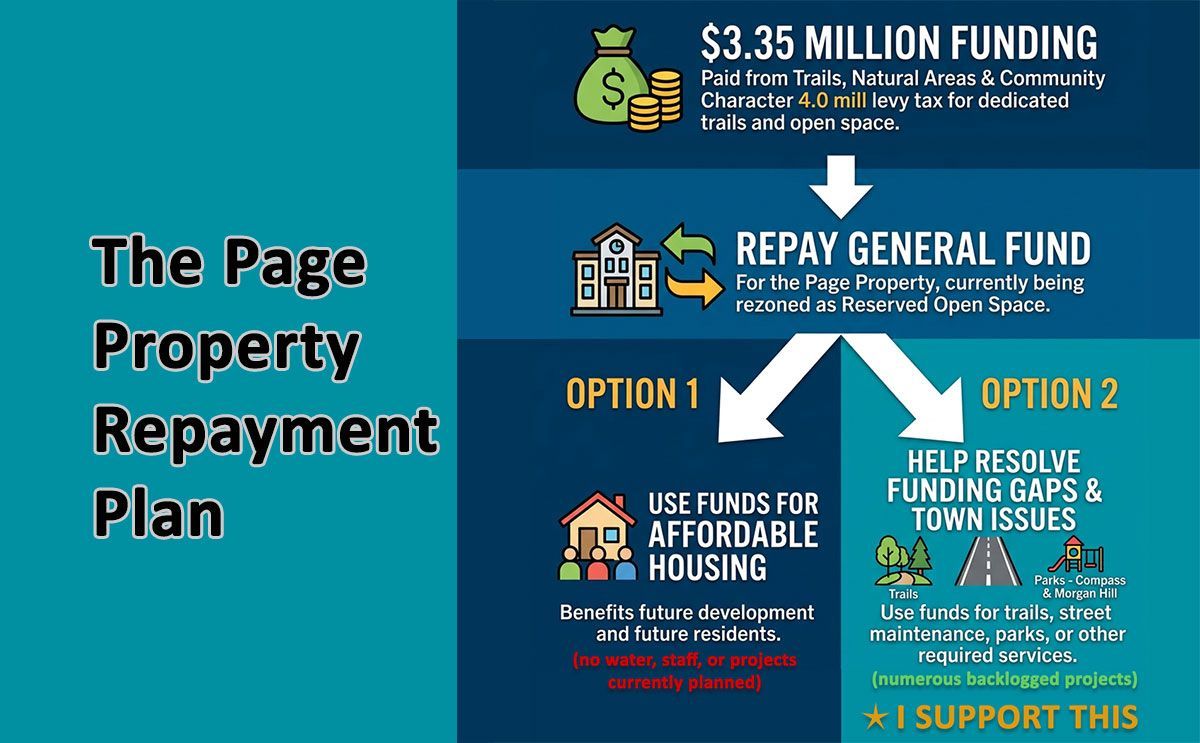
The Town owned Page Property is currently moving through the steps of being rezoned as Reserved Open Space. Because half of the property was originally purchased using ARPA Federal grant funds, $3.35 million from our TNACC 4.0 mill levy tax funds will be used to repay the General Fund. Should TNACC property tax be used to fund Affordable Housing (future development, future residents), or to support critical or required Town needs and services (current residents)?  With the Town currently experiencing significant budgetary issues and funding constraints, personally, the choice is clear: we should use the funds for general town services that help current residents – not affordable housing, which serves future development and future residents.
By Andrew Sawusch • October 9, 2026
Traditional political campaigns are full of broad platforms, general stances, and lofty promises, but they rarely tell how things will actually get fixed. This bridges that gap by offering concrete, immediate solutions rather than just vague goals. I break down 10 practical, actionable policy shifts into single-focus topics. Each highlights one specific, manageable change that can be tackled right away to build momentum in the first 100 days.
By Andrew Sawusch • September 21, 2026
An interview with Andrew Sawusch - candidate for Town of Erie Town Council District 1, current Town of Erie Planning Commission Chair, former Town of Erie Council Member - for YellowScene Magazine (Salem Goodman). Interview conducted on September 14, 2026.
By Andrew Sawusch • August 26, 2026
Public Comment provided at the August 25, 2026 Town of Erie Council Meeting  Ordinance 31-206: An Ordinance of the Town Council of the Town of Erie Repealing Ordinance No. 028-2026 Authorizing the Sale of Minerals to 7N, LLC, Accepting the Conveyance of Real Property from 7N, LLC, and Approving Agreements with 7N, LLC, SM Energy Company, and Extraction Oil and Gas, Inc.
By Andrew Sawusch • August 23, 2026
The Town's Finance team has indicated that we will be exhausting our Capital Improvement Fund by 2028. When this occurs, we will not even have enough money to fund such things as our street maintenance needs. In response, Staff has recommended the priority of sustaining this CIF fund, which to do so includes a 10% cut across all departments. As well, they are recommending a new fee be added to our utility bills - a dedicated "Transportation Maintenance Fee" - in order to ensure we have adequate funding for street maintenance in the future. All of this is currently being done to answer one question: How do we pay for our capital needs? Personally, I believe this is the single most important issue facing the Town. It has the potential to affect our everyday life as residents, impacting us in ways both big and small. A concerted effort must be made to stabilize our budget in order to avoid a cascading affect that detrimentally affects all Town services.
Projected to be depleted by 2027, Erie's finance team forecasts the Town's Capital Fund
By Andrew Sawusch • September 2, 2024
Projected to be depleted by 2027, Erie's finance team forecasts the Town's Capital Fund to only have $2.5million available for capital projects (after $4million Street Maintenance) from 2027 through 2029 — due to overspending caused by operational and capital expenses exceeding the growth of revenues
By Andrew Sawusch • March 22, 2022
While some call it an "Affordable Housing" issue, in reality the root of the problem is a lack of housing diversity. During the Town's massive growth over the years, a lack of available inventory and the national housing market have created a housing affordability issue as the Town's makeup has comprised almost entirely of single family homes. The best way to resolve this issue is to work with our stakeholders in the community - our development partners - to address the cause, not the symptoms of the issue.
Show More

Ready to Continue Serving Erie Residents

I will continue to maintain a critical eye of where our tax payer money is used, to ensure that the Town's growth can be managed properly. My full energy has been used to build a solid foundation for Erie's future, instead of playing catch-up and thinking of actions in hindsight. As a business-minded individual, I will continue to remove ineffectiveness in our town, replacing it with efficiency that we can all be proud of.